Exercise · Getting started
Leaking during exercise is far more common than anyone admits, and giving up training is the one response that reliably makes things worse. Here is what the evidence actually supports.
You stopped going to the class. Or you started running shorter routes. Or you swapped the thing you enjoyed for something you tolerate, because it felt safer.
You did not make an announcement about it. You just quietly adjusted — and that adjustment is far more common than the conversation around it suggests.
How common this actually is
That third figure is the one worth pausing on. In a study of female athletes with urinary incontinence, 95.5% had never discussed it with a health professional, and every athlete in the focus group described emptying their bladder preventively before training.3
In the gymnastics and cheerleading study, 41% of the athletes had never heard of the pelvic floor muscles at all — while 74% said they would be interested in training them.2 The gap there is not motivation. It is information.
So if you have been managing this privately and assuming you are unusual: you are not, and the people around you in the class are statistically likely to be doing the same.
The honest part: impact does load the pelvic floor
Most articles on this subject imply that exercise is straightforwardly good for incontinence. The evidence is more complicated than that, and you deserve the accurate version.
High-impact exercise is a documented risk factor. A meta-analysis of eight studies found that female athletes carried a 177% higher risk of urinary incontinence than sedentary women.1 Jump-based movements in particular are consistently associated with leakage.4
The mechanism is straightforward. Running, jumping, skipping and heavy lifting all produce sudden spikes in abdominal pressure. Your pelvic floor has to resist that pressure in a fraction of a second. When the demand exceeds what those muscles can currently produce, urine escapes.
This is not a reason to stop. It is a reason to understand what you are asking of your body, and to build the capacity to meet it.
The distinction that matters: impact does not damage your pelvic floor. It reveals whether your pelvic floor can currently handle that load.
Which means the answer is to increase the capacity — not to permanently reduce the demand.
Why stopping is the wrong answer
Three reasons.
It does not fix the incontinence. Avoiding the activity that triggers leakage removes the symptom in that moment. It does nothing to the underlying muscle weakness, which continues regardless of whether you attend the class.
It costs you the wider benefits. Cardiovascular health, bone density, muscle mass, sleep, mood, weight management. Menopause is precisely the period when those benefits matter most, and it is also when many women quietly stop.
The adaptations compound. In the gymnastics study, 22% of athletes said they would sometimes avoid training or specific exercises because of leakage.2 Once avoidance starts, it tends to expand — first one movement, then one class, then the activity altogether.
Which activities load the pelvic floor least
Not all exercise creates equal pressure. If you are starting again, start where the load is lowest.
| Activity | Load | Notes |
|---|---|---|
| Swimming, water aerobics | Lowest | Water supports body weight. Often the most comfortable starting point. |
| Walking | Low | Accessible, repeatable, easy to build gradually. |
| Cycling | Low | No impact. Check saddle comfort — pressure on the perineum can irritate. |
| Pilates | Low | Directly trains deep core and pelvic floor coordination. |
| Gentle yoga | Low | Restorative and yin styles. Avoid fast vinyasa flows early on. |
| Resistance training | Moderate | Fine with controlled load and exhaling on effort. Avoid breath-holding. |
| Elliptical, brisk walking | Moderate | Good bridge between low and high impact. |
| Running | High | Repeated impact. Reintroduce with run-walk intervals. |
| Jumping, skipping, HIIT, CrossFit | Highest | Jump-based movements are most strongly associated with leakage.4 |
Starting low is not a permanent demotion. It is the on-ramp.
Build the foundation first
Pelvic floor muscle training is the intervention with the strongest evidence base, and in reviews of physiotherapy for female athletes it is the approach most consistently used — usually combined with basic education about pelvic anatomy.5
Finding the right muscles
Imagine stopping yourself from passing wind and stopping the flow of urine at the same time. That inward-and-upward lift is your pelvic floor. Buttocks, thighs and stomach stay relaxed — visible movement means you are recruiting the wrong muscles.
Given that 41% of athletes in one study had never heard of these muscles, it is worth saying plainly: this is a skill, and most people get it wrong at first.
The routine
- Slow holds for endurance — lift and hold 5 seconds, release fully for 5 seconds, 10 times
- Quick pulses for the fast reflex that resists a jump or a sneeze — lift and release quickly, 10 times
One set of each, three times daily. Roughly three minutes. Release fully between repetitions — a permanently tense pelvic floor is as dysfunctional as a weak one.
"The knack"
Contract deliberately just before the moment of pressure — before the jump, the lift, the cough. It takes practice to become automatic, and it is one of the more useful things you can learn early.
A twelve-week on-ramp
Clinical trials of pelvic floor training generally run a minimum of three months, so twelve weeks is a reasonable frame for both the training and the return to activity.
| Weeks | Training | Pelvic floor work |
|---|---|---|
| 1–4 | Low-load only: walking, swimming, cycling, Pilates, gentle yoga | Daily practice. Focus on isolating the correct muscles. |
| 5–8 | Add controlled resistance training. Exhale on effort, no breath-holding. | Continue daily. Begin using the knack before lifting. |
| 9–12 | Introduce moderate impact: brisk walking, elliptical, short run-walk intervals | Continue daily. The knack should be becoming automatic. |
| 12+ | Reintroduce higher-impact activity if you want it, one element at a time | Maintenance. Stopping entirely reverses gains over time. |
This is a framework, not a prescription. Some women move faster, others need longer, and progress is rarely linear.
Leakage at your current level has reduced noticeably, you complete sessions without preoccupation, and the thought of adding one element does not create anxiety. If any of those are missing, hold at the current stage for another fortnight. Rushing the progression is the most common reason women conclude that "it isn't working."
Practical tactics for the session itself
Empty your bladder before, but do not overdo it
Going before you train is sensible. Going repeatedly "just in case" is the habit that teaches your bladder to signal earlier and at lower volumes — and it was described by every athlete in one focus group.3 Once before you start is enough.
Do not train dehydrated
Restricting fluid is the instinct and it backfires. Concentrated urine irritates the bladder and increases urgency. Drink normally.
Time your caffeine
If coffee is part of your pre-workout routine and you get urgency, try moving it two to three hours earlier for a fortnight and see whether it changes anything. Caffeine affects people to very different degrees.
Breathe out on the effort
Holding your breath during a lift dramatically increases abdominal pressure. Exhale on exertion. It is a small technical change with a real effect.
Wear something you trust
This matters more than it sounds. The mental load of wondering whether something will show is a genuine distraction, and it is the thing that most often stops women committing to a class.
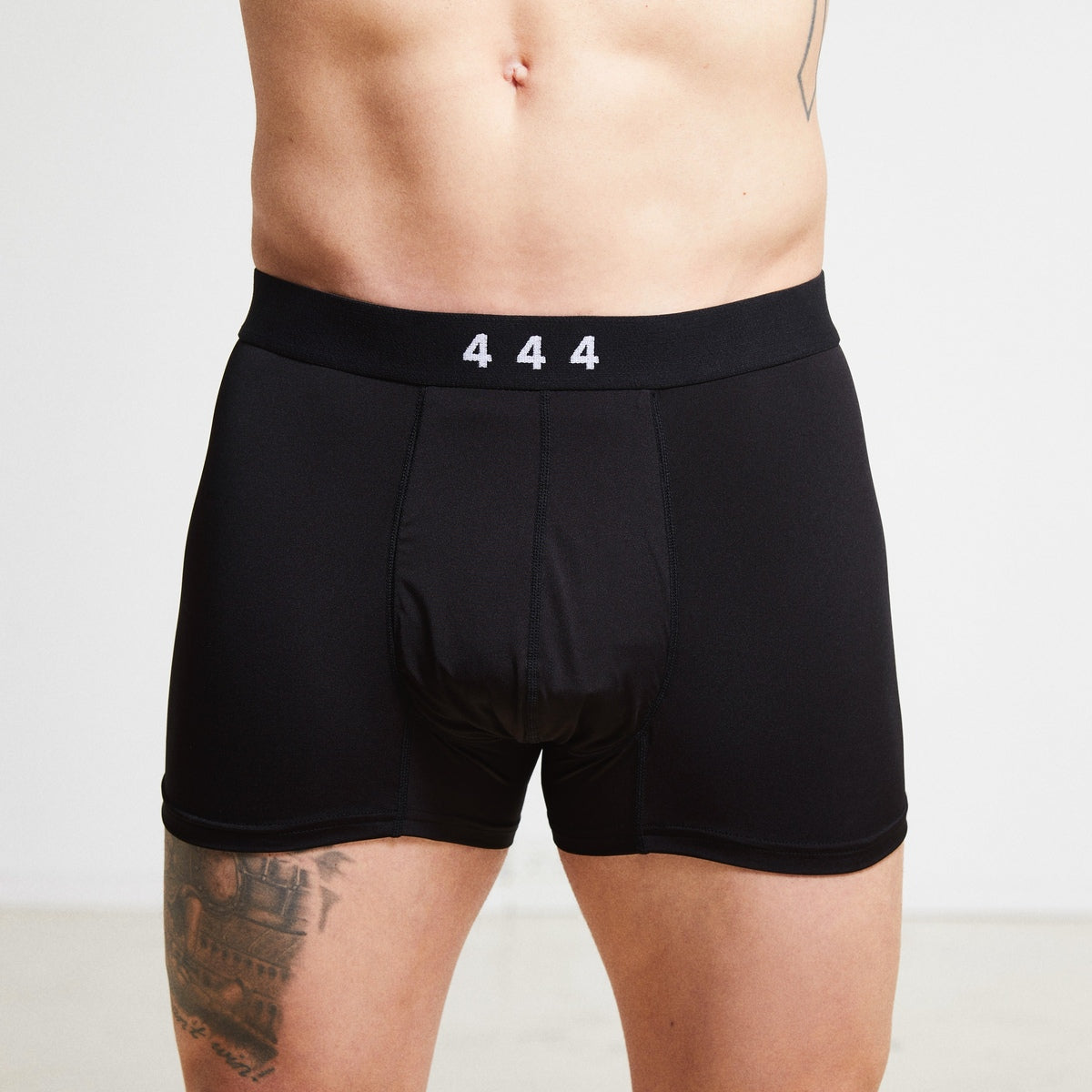
High-waisted absorbent underwear tends to work better than a mid rise during exercise, because the band anchors above the hip and resists rolling or shifting during bending and impact. Elva High 90 suits most training sessions; Elva High 350 is the choice for longer sessions or if you want more margin.
Both are CE-marked medical devices, thin enough to wear under leggings, and washable at 60 degrees. If you are unsure which level, the absorbency guide walks through it.
When to see a physiotherapist
A referral to a pelvic floor physiotherapist is worth pursuing for almost anyone, and particularly if:
- You are unsure whether you are contracting correctly — this is common and difficult to self-assess
- Twelve weeks of consistent training has produced no change
- You want to return to a specific high-impact sport and want a structured plan
- You feel heaviness or a bulge in the vagina, which can indicate prolapse
- You experience pain during or after exercise
See a doctor promptly, not eventually
Blood in the urine, pain or burning when passing urine, sudden onset of symptoms, or difficulty emptying your bladder fully all warrant medical attention rather than a training plan.
Common questions
Will running make my incontinence permanently worse?
High-impact activity is associated with higher incontinence prevalence, but the evidence does not show that it causes lasting damage in otherwise healthy women. The sensible approach is to build pelvic floor capacity first and reintroduce impact gradually rather than avoiding it indefinitely.
Should I do Kegels while I exercise?
Use the knack — a deliberate contraction immediately before a moment of pressure. Holding a contraction continuously throughout a session is neither necessary nor helpful, since the muscles need to relax as well as contract.
Is it safe to lift weights?
Yes, with controlled load and correct breathing. Exhale on the effort rather than holding your breath, and increase weight gradually. Resistance training is valuable during menopause for bone density and muscle mass.
How long before I can go back to my class?
Many women manage a modified return within weeks and a full return within three to six months. If the class is high-impact, consider speaking to the instructor about scaling particular movements — most are entirely used to adapting for individuals.
Do I have to tell my instructor?
No. But if you feel able to, most instructors will simply offer alternatives for specific movements without any discussion of why.
Where to start this week
- Choose one low-load activity you actually enjoy and do it twice this week
- Start pelvic floor training today — three minutes, three times daily, and commit to twelve weeks before judging it
- Sort out protection so the question of whether something will show stops occupying your attention
- Ask about a physiotherapy referral, particularly if you are not confident you are doing the exercises correctly
The women who get back to what they stopped are not the ones with the least leakage. They are the ones who kept moving while they worked on it.
Training gear for the part nobody sees
High-waisted, thin enough for leggings, and engineered to stay exactly where you put it. CE-marked and washable.
See the women's collection →Sources
- Teixeira RV et al. Prevalence of urinary incontinence in female athletes: a systematic review with meta-analysis. International Urogynecology Journal, 2018 (8 studies; 36% prevalence; 177% higher risk vs sedentary women).
- Urinary and anal incontinence among female gymnasts and cheerleaders — bother and associated factors. 2022 (319 athletes; 67% UI prevalence; 41% unaware of pelvic floor muscles; 22% avoided training).
- Prevalence and impact of urinary incontinence among female athletes. 2011 (41.5% prevalence; 95.5% had never discussed it with a health professional).
- Prevalence of urinary incontinence in female CrossFit athletes: a systematic review with meta-analysis. International Urogynecology Journal, 2022 (jump-based exercises associated with leakage).
- Urinary Incontinence in Female Athletes: A Systematic Review on Prevalence and Physical Therapy Approaches. 2024.
This article is general information, not individual medical advice. If your symptoms are new, sudden, painful, or accompanied by blood in the urine, speak to your doctor before beginning an exercise programme.